
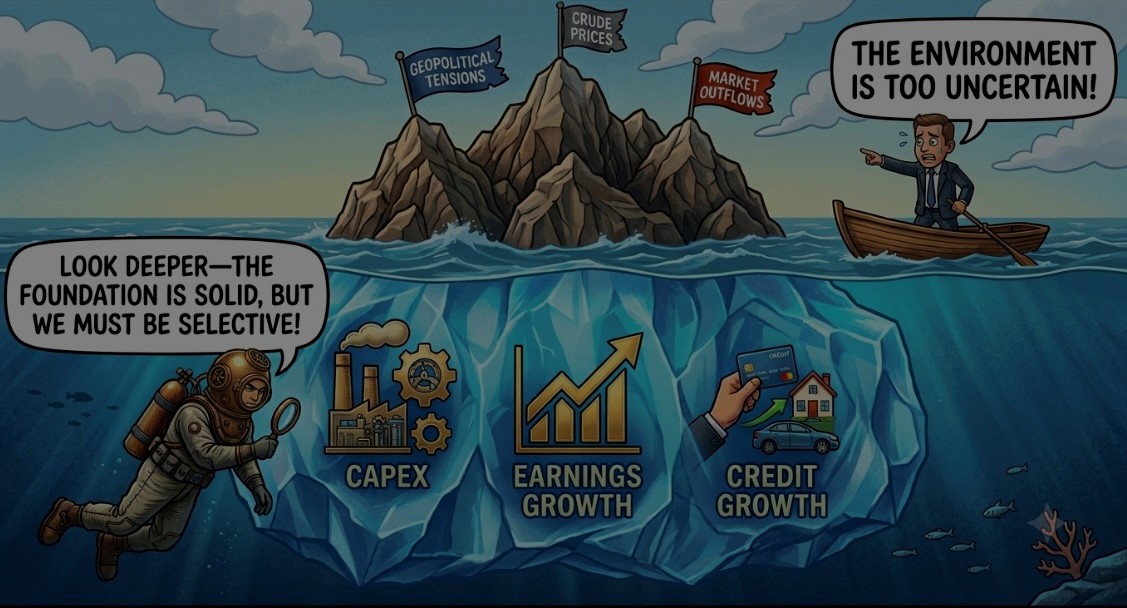

When markets are uncertain, look beyond the index
The investment environment has become considerably more demanding. Elevated crude oil prices, geopolitical tensions, foreign investor outflows and higher global bond yields have weighed on sentiment towards Indian equities. Such periods inevitably raise a question: has the investment opportunity in India weakened, or are investors witnessing a phase in which prices, earnings expectations and long term business prospects are being reassessed?
At AAA, we believe the answer requires a closer examination of the underlying evidence.
India continues to benefit from domestic investment, a large consumption base, expanding formal credit and structural opportunities across manufacturing and services. Corporate earnings momentum warrants renewed attention, while the divergence in market performance reinforces the importance of looking beyond headline indices.
None of this makes equities immune to further volatility. Nor does a market correction automatically make stocks attractive.
The opportunity lies in identifying businesses where sustainable earnings growth, competitive strength and valuation converge without compromising on the protection of capital.
- India’s macroeconomic resilience is supported by tangible investment
Government investment in infrastructure, domestic consumption, formal credit growth and services exports remain important drivers of economic activity.
System liquidity stands at Rs. 8tn, supported by record inflows of $125bn through the FCNR(B) window. Retail credit growth accelerated from 14.6% yoy in Dec’25 to 16.2%, led by vehicle loans. Improving credit scores among prime plus customers have driven a sharp increase in consumer loan originations (Refer to Fig 1). Indian consumer spending has witnessed significant growth as reflected in auto registration and other discretionary consumption categories. Corporates have deleveraged since FY15; credit to industry is now growing 20% yoy, the fastest since FY11. Capacity utilisation, exports and project announcements rising.
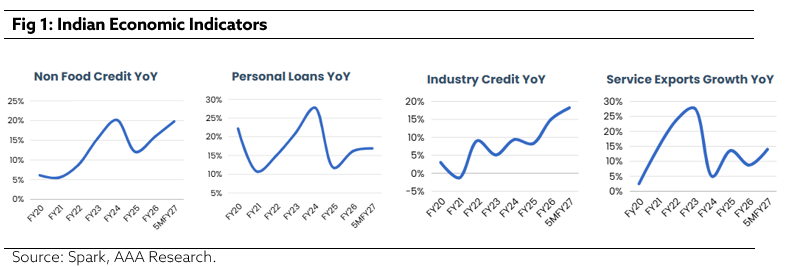
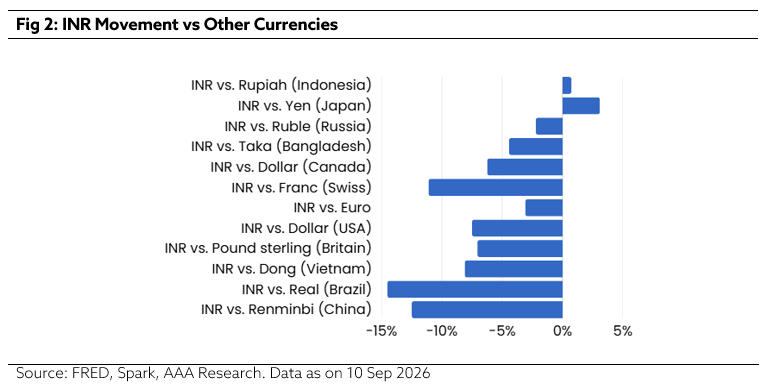
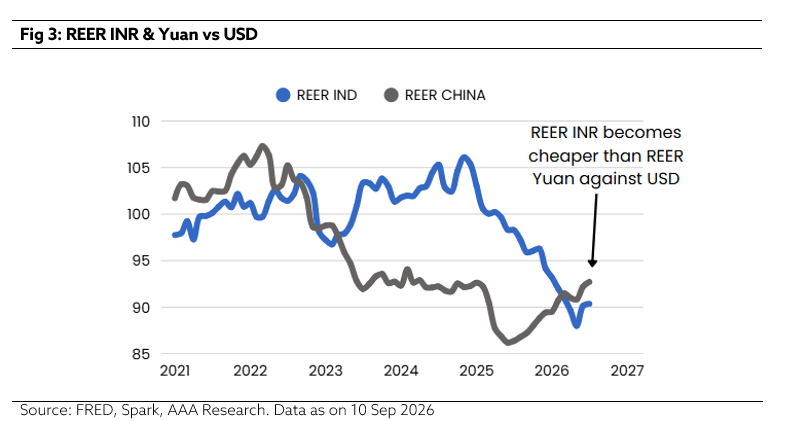
India’s external position could also see further meaningful improvement over the next 12–18 months (Refer to Fig 1). A more competitive rupee, in both nominal and real terms, could strengthen export competitiveness, while trade agreements with the US, EU and UK could unlock incremental opportunities across auto ancillaries, engineering goods, EMS, textiles and chemicals (Refer to Fig 2 & Fig 3). Together, these factors could help contain the current account deficit below 1.5% of GDP and potentially signal an inflection point in India’s Balance of Payments (BoP) trajectory. A strengthening external position would add to macroeconomic resilience and provide another structural support for India’s long term growth story.
- The market’s recent performance conceals important differences
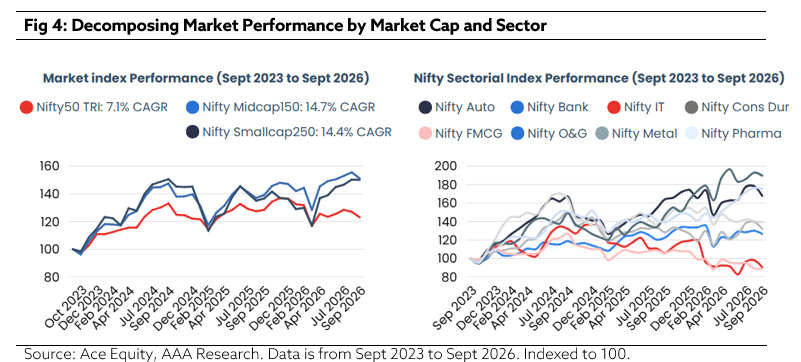
The recent experience of Indian equities is more nuanced than the headline market narrative suggests. Between September 2023 and September 2026, the reported annualised returns difference is instructive. While large cap returns were more modest over this period, midcap and small cap indices delivered higher annualised returns (Refer to Fig 4).
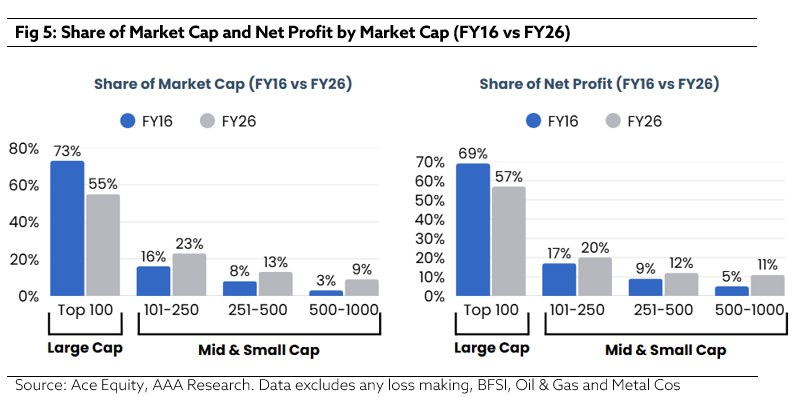
This is supported by a fundamental shift in India’s corporate profit pool. Over the last decade, large caps’ share of total corporate profits has declined from 69% to 57%, while their share of total market capitalisation has fallen from 73% to 55% (Refer to Fig 5). In contrast, small cap companies (market cap ranks 250 to 1,000) have nearly doubled their contribution to the total profit pool, increasing from 14% to 23%. This shift highlights the growing role of smaller companies in India’s earnings growth and wealth creation, providing a fundamental rationale for looking beyond large caps.
The next phase of returns is likely to depend increasingly on company specific factors: earnings delivery, competitive positioning, balance sheet strength and the valuation at which investors enter. Broad market sentiment is a useful starting point, but it cannot replace bottom up research.
- Earnings momentum deserves closer attention
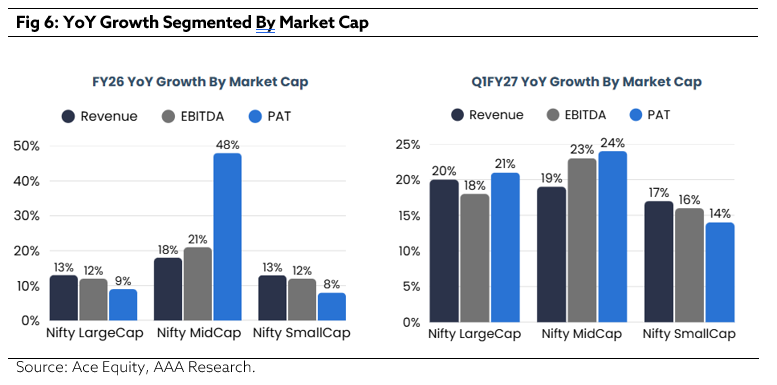
Share prices can remain disconnected from business fundamentals for extended periods. Over time, however, sustainable earnings and cash flow generation are central to the creation of equity value. Our analysis of corporate earnings points to improving momentum across market cap segments in Q1 FY27, following a more varied FY26 performance (Refer to Fig 6).
This matters because a recovery supported by actual earnings delivery is fundamentally different from one driven primarily by a change in market sentiment.
The distinction is especially important in a market where investors are reassessing valuations. Businesses that can sustain revenue growth, protect margins and generate cash despite external uncertainty are better positioned to compound value over time. An improvement in aggregate earnings is encouraging, but it is not a substitute for company level analysis. The quality and durability of growth matter as much as its reported rate.
- The scarcity of consistent earnings growers strengthens the case for active management
One of the most revealing findings in our research is how few companies sustain high earnings growth across an entire business cycle. Our analysis found that no large cap companies consistently grew PAT by 20% through FY22–FY26. In fact only 8.4% of the mid and small cap companies we studied consistently grew PAT by 20% through FY22–FY26. This is a critical distinction between identifying a fast growing business and identifying a durable compounder. A company may report exceptional growth during a favourable industry cycle. Sustaining that performance through changing demand, rising input costs, competition and tighter financing conditions is considerably more difficult. The ability to navigate these transitions depends on business quality, management execution, financial strength and competitive advantage. It also requires investors to recognise when an investment thesis is weakening rather than holding on to a company simply because it once delivered strong growth. This is where disciplined active management becomes important.
At AAA, our investment process combines quality led stock selection with agile portfolio construction. Our 3M framework, Market Size, Market Share and Margin of Safety, helps assess the opportunity, competitive position and price paid for a business.
Our forensic and longevity frameworks add scrutiny around governance, earnings quality and balance sheet strength.
The objective is not to own every business participating in a growth theme. It is to identify those capable of translating opportunity into sustainable shareholder value.
- Market weakness can improve prospective returns but only selectively
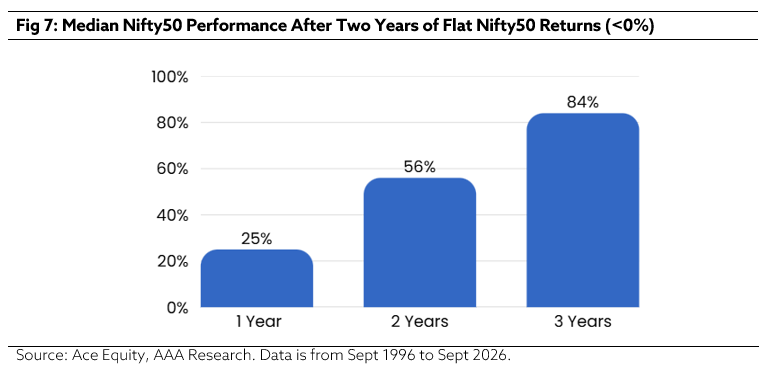
Historical market data provides a useful perspective on the relationship between prolonged weakness and subsequent returns.
Our research examines periods when the Nifty 50 delivered flat or negative returns over two years. In the historical analysis, median cumulative returns over the subsequent one, two and three years were approximately 25%, 56% and 84%, respectively (Refer to Fig 7). These observations are not a forecast for the next three years. Historical outcomes vary considerably, and the timing of a recovery cannot be predicted reliably from past market patterns alone. Their relevance is more fundamental: recent returns should not be the only basis for assessing future investment potential. When prices decline more sharply than the long term earning power of a business, prospective returns can improve. When the decline reflects a permanent deterioration in the business, a lower share price may still offer poor value. This distinction should shape investment decisions during periods of volatility.
- What should investors do now?
The present environment calls for neither indiscriminate buying nor an automatic retreat from equities. It calls for a deliberate assessment of portfolio positioning.
For investors with a long investment horizon who remain under allocated to equities, a phased increase in allocation may be worth considering, subject to liquidity needs and risk tolerance. For investors who already have an appropriate equity allocation, the priority should be to assess the quality of their holdings rather than simply increase exposure because prices have fallen.
Across portfolios, our QuAgility philosophy, Quality with Agility, is anchored in five essential disciplines:
- Prioritise business quality. Invest in companies with durable competitive advantages, sound governance, strong cash generation and sustainable growth potential.
- Maintain valuation discipline. Even the best businesses can deliver poor returns if purchased at excessive valuations.
- Protect capital through proactive risk management. Assess balance sheet strength, manage position sizing and remain mindful of downside risks.
- Stay agile and exit decisively. Continuously reassess investment theses and do not hesitate to exit when fundamentals deteriorate, expectations change or the original investment rationale no longer holds.
- Invest with the right horizon. Align equity exposure with long term financial objectives and the ability to withstand volatility, rather than attempting to predict short term market movements.
Our perspective
India’s long term growth opportunity remains supported by domestic investment, expanding economic activity and a broad set of structural business opportunities. At the same time, external risks, valuation differences and the uneven nature of earnings recovery require investors to be selective.
At AAA, our focus remains on identifying quality businesses with sustainable growth potential at sensible valuations, while maintaining a disciplined exit strategy when the facts change.
The objective is not to predict every market turn. It is to make sound investment decisions through the cycle.
DISCLAIMER: This document is not for public distribution and has been furnished to you solely for your information and may not be reproduced or redistributed to any other person. The manner of circulation and distribution of this document may be restricted by law or regulation in certain countries, including the United States. Persons into whose possession this document may come are required to inform themselves of, and to observe, such restrictions. This material is for the personal information of the authorized recipient, and we are not soliciting any action based upon it. This report is not to be construed as an offer to sell or the solicitation of an offer to buy any security in any jurisdiction where such an offer or solicitation would be illegal. No person associated with AlfAccurate Advisors Pvt Ltd is obligated to call or initiate contact with you for the purposes of elaborating or following up on the information contained in this document. The material is based upon information that we consider reliable, but we do not represent that it is accurate or complete, and it should not be relied upon. Neither AlfAccurate Advisors Pvt Ltd., nor any person connected with it, accepts any liability arising from the use of this document. The recipient of this material should rely on their own investigations and take their own professional advice. Opinions expressed are our current opinions as of the date appearing on this material only. While we endeavour to update on a reasonable basis the information discussed in this material, there may be regulatory, compliance, or other reasons that prevent us from doing so. Prospective investors and others are cautioned that any forward-looking statements are not predictions and may be subject to change without notice. We and our affiliates, officers, directors, and employees worldwide, including persons involved in the preparation or issuance of this material may; (a) from time to time, have long or short positions in, and buy or sell the securities thereof, of company (is) mentioned herein or (b) be engaged in any other transaction involving such securities and earn brokerage or other compensation or act as a market maker in the financial instruments of the company (is) discussed herein or may perform or seek to perform investment banking services for such company(is)or act as advisor or lender / borrower to such company(is) or have other potential conflict of interest with respect to any recommendation and related information and opinions. The same persons may have acted upon the information contained here. No part of this material may be duplicated in any form and/or redistributed without AlfAccurate Advisors Pvt Ltd.’s prior written consent. No part of this document may be distributed in Canada or used by private customers in the United Kingdom. In so far as this report includes current or historical information, it is believed to be reliable, although its accuracy and completeness cannot be guaranteed.
AlfAccurate Advisors Private Limited is registered with SEBI as a Portfolio Manager having SEBI registration number – INP000003419 and as an Investment Advisor having SEBI registration number – INA000015701. AAA India Equity Fund – Scheme 1 and AAA GEMS Fund are open-ended schemes of AAA India Equity Fund, a Category III Alternative Investment Fund having SEBI registration number – IN/AIF3/22-23/1226 managed by AlfAccurate Advisors LLP (collectively referred as “AAA”).